Society ·
DAOs and the old idea of the cooperative
Do decentralized autonomous organizations reinvent cooperativism or just change its vocabulary?
By Colab · 8 min read
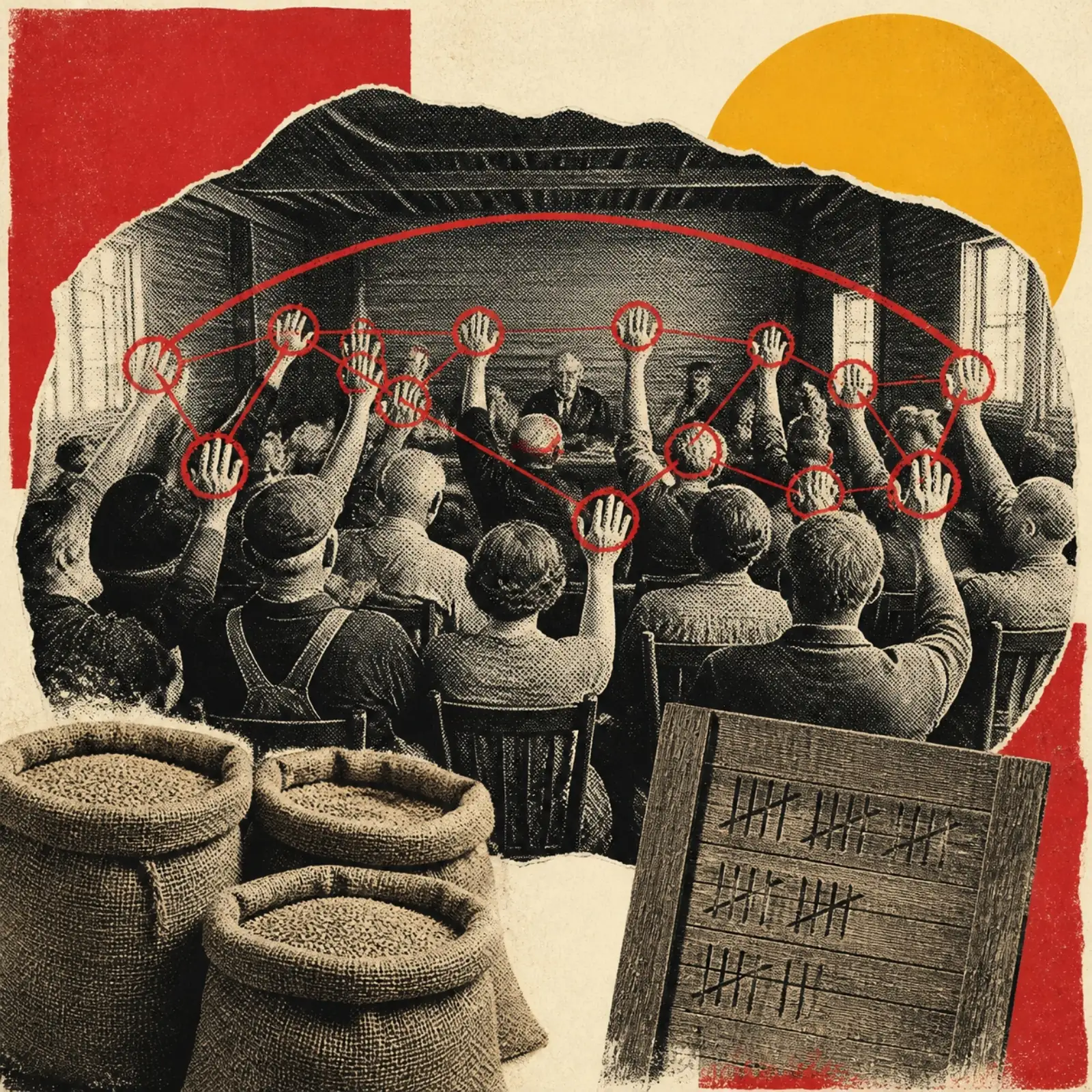
Long before blockchain, governance tokens and smart contracts, workers were already trying to answer a question that remains surprisingly relevant: is it possible to organize an economic activity without handing all the power to those who provide the capital?
Cooperativism was born from concrete experiences of this kind.
Two centuries later, part of the crypto world presents a seemingly new proposal. These are the so-called decentralized autonomous organizations, or DAOs: communities that use blockchain, tokens, smart contracts and digital voting mechanisms to coordinate resources and make decisions collectively.
The vocabulary is new.
The political question, not so much.
When a DAO promises to replace hierarchical corporate structures with distributed ownership and collective decisions, it enters a debate that predates the internet itself.
So perhaps the more interesting question is not whether DAOs will replace cooperatives, but what two traditions separated by almost two centuries can learn from each other.
An old idea: those who take part also decide
The first modern cooperative experiences emerged in the context of nineteenth-century European industrialization.
Their fundamental principle was relatively simple: an economic organization did not necessarily have to belong to outside investors. Consumers, producers or workers could be participants and owners at the same time.
The cooperative tradition developed its own governance principles. Among them are members' economic participation, autonomy, cooperative education and democratic control.
It is important to note a fundamental difference from capital-based companies.
In a conventional company, influence tends to follow economic ownership.
Whoever owns more shares usually has more votes.
In the classic cooperative model, the logic can be different: one person, one vote.
This does not eliminate internal disputes, administrative problems or informal inequalities. Cooperatives are human organizations and face the same challenges of participation, efficiency and representation found in other institutions.
But they introduce a powerful idea:
capital and political power within an organization do not have to be exactly the same thing.
The promise of DAOs
DAOs emerge from a different historical context.
Instead of factories and local associations, their natural environment is geographically distributed digital communities.
Their rules can be partly executed by smart contracts. Treasuries can be recorded on a blockchain. Proposals can be presented publicly and decisions can be put to a vote of the participants.
This creates interesting features.
People who have never been in the same country can manage resources together.
The organization's transactions can be audited directly on a public blockchain.
Rules can be automated.
Decisions can be recorded verifiably.
And an organization can operate without exactly reproducing the traditional structure of executives, board and shareholders.
Researchers who study DAOs have observed precisely this potential to reduce certain coordination and information costs.
But there is a considerable distance between decentralizing an infrastructure and democratizing an organization.
One token, one vote?
Here lies perhaps the most important difference between part of the DAO world and the cooperative tradition.
Many DAOs use models in which voting power is tied to the number of tokens a person controls.
The more tokens, the greater the influence.
From a technical standpoint, it is a simple way to organize governance.
From a political standpoint, the result deserves attention.
If 1% of participants hold a very large share of the tokens, an organization can use blockchain, digital voting and smart contracts and still show a strong concentration of power.
Technological decentralization, therefore, does not guarantee economic democracy.
It is possible to build an organization without a president and still create a small elite able to determine a large share of the decisions.
The problem is not exclusive to DAOs.
Representative democracies, companies, associations and even cooperatives face similar difficulties: low participation, information asymmetries, the formation of dominant groups and informal concentration of influence.
Technology did not invent this problem.
Nor did it solve it.
The return of a classic question
It is precisely at this point that researchers began to bring DAOs and cooperativism closer together.
Kelsie Nabben and other researchers have argued that DAOs could learn from decades of experience accumulated by cooperatives in participatory governance.
More recently, Morshed Mannan and Simon Pek compared corporate digital platforms, cooperative platforms and platforms organized as DAOs.
The work, published in 2026 in the Journal of Co-operative Organization and Management, reaches a particularly interesting conclusion: perhaps the most promising innovation lies not in replacing one model with the other, but in hybrid forms, cooperative DAOs.
The idea deserves attention.
Blockchain could provide infrastructure for coordination, transparency and rule enforcement.
Cooperativism would provide institutional principles built over almost two centuries to deal with participation, ownership and the distribution of power.
In this encounter, innovation would not lie in erasing the past.
It would lie in digitizing it without losing what it has learned.
Governance is not just voting
There is another important lesson from the cooperative experience.
Organizational democracy does not consist only of putting decisions to a vote.
A community in which few people understand the proposals and thousands simply click “yes” or “no” can have voting without having real participation.
Cooperatives have historically placed importance on educating their members precisely because participation requires knowledge.
This principle reappears in the debate on DAOs.
Researcher Alyce Jean Thomas argues that education should also have a significant place in DAO-based cooperative organizations.
The question seems secondary, but it is not.
Imagine a complex proposal involving a protocol change, a token's monetary policy or the use of millions belonging to the treasury.
Formally, everyone can vote.
In practice, how many can understand the consequences?
Democracy does not depend only on the right to take part.
It depends on the conditions needed for that participation to be meaningful.
What about work?
There is an even more important dimension for a left-wing analysis: who captures the value produced?
Much of today's digital economy runs through platforms.
Drivers, couriers, content creators, programmers and other workers use infrastructures owned by private companies.
The platform connects people, organizes transactions and sets the rules.
But ownership remains concentrated.
Platform cooperativism emerged precisely as a response to this model: what if workers themselves were also owners of the digital infrastructure?
DAOs add a new technical possibility to this discussion.
A platform could distribute governance and part of the ownership among participants using blockchain.
But again, everything depends on institutional design.
If workers receive a small number of tokens while investors hold most of them, the technology has changed, but not necessarily the economic relationship.
The central question is still an old one:
who works, who owns and who decides?
Code does not eliminate institutions
There is a certain technological fascination with the idea of replacing trust with code.
It has a basis: smart contracts can automate commitments that previously depended on intermediaries.
But societies are more complicated than contracts.
There are unforeseen situations.
There are conflicts.
There are errors.
There are changes in circumstances.
There is informal power.
Recent research on the institutional nature of DAOs shows precisely that their survival depends on the capacity to adapt and cooperate, not just on automation.
Code can execute a rule.
It does not decide on its own whether the rule is still fair.
That will remain a political task.
A technology in search of institutions
It may be too early to know whether DAOs will become a lasting organizational form or remain concentrated in certain niches of the digital economy.
But the experiment deserves attention.
There is something politically interesting in the attempt to build global organizations whose treasury can be publicly audited, whose decisions can be recorded verifiably and whose participants can coordinate resources without necessarily creating a conventional company.
At the same time, it would be naive to imagine that blockchain eliminates the historical problems of human organizations.
Concentration of wealth still produces concentration of influence.
Participation still requires time and knowledge.
Conflicts still need resolution mechanisms.
And ownership is still a political question.
Perhaps that is why the encounter between DAOs and cooperativism is more interesting than the attempt to present one as a substitute for the other.
DAOs can offer new tools to cooperativism.
Cooperativism can offer DAOs something no protocol can generate on its own:
institutional memory.
After almost two hundred years, technology has changed profoundly.
The question remains familiar.
Should those who take part in creating wealth also take part in the decisions about it?
Blockchain does not answer.
But it may become one of the tools used to build the answer.
References
- 01MANNAN, Morshed; PEK, Simon. Corporate Platforms to Cooperative DAOs: Understanding the potential and problems of a plurality of digital labor platform archetypes. Journal of Co-operative Organization and Management, v. 14, n. 1, 2026.
- 02NABBEN, Kelsie; PUSPASARI, Novita; KELLEHER, Megan; SANJAY, Sadhana. Grounding Decentralised Technologies in Cooperative Principles: What Can Decentralised Autonomous Organisations (DAOs) and Platform Cooperatives Learn from Each Other? 2021.
- 03THOMAS, Alyce Jean. DAOs, cooperatives and the educational principle. Law, Ethics & Technology, v. 1, n. 1, 2024.
- 04SANTANA, Carlos; ALBAREDA, Laura. Blockchain and the emergence of Decentralized Autonomous Organizations (DAOs): An integrative model and research agenda. Technological Forecasting and Social Change, v. 182, 2022. In the Library
- 05GHIRLANDA, Pietro; KIROV, Vassil. An alternative organizational model for a more democratic and equitable digital economy: A systematic literature review on platform cooperativism. Annals of Public and Cooperative Economics, v. 95, n. 4, 2024. In the Library