
Crypto ·
Bitcoin and the question of sovereignty
Can a stateless currency expand the autonomy of peripheral countries, or does monetary sovereignty still depend on national institutions?
By Redação Esquerda Cripto · 9 min read
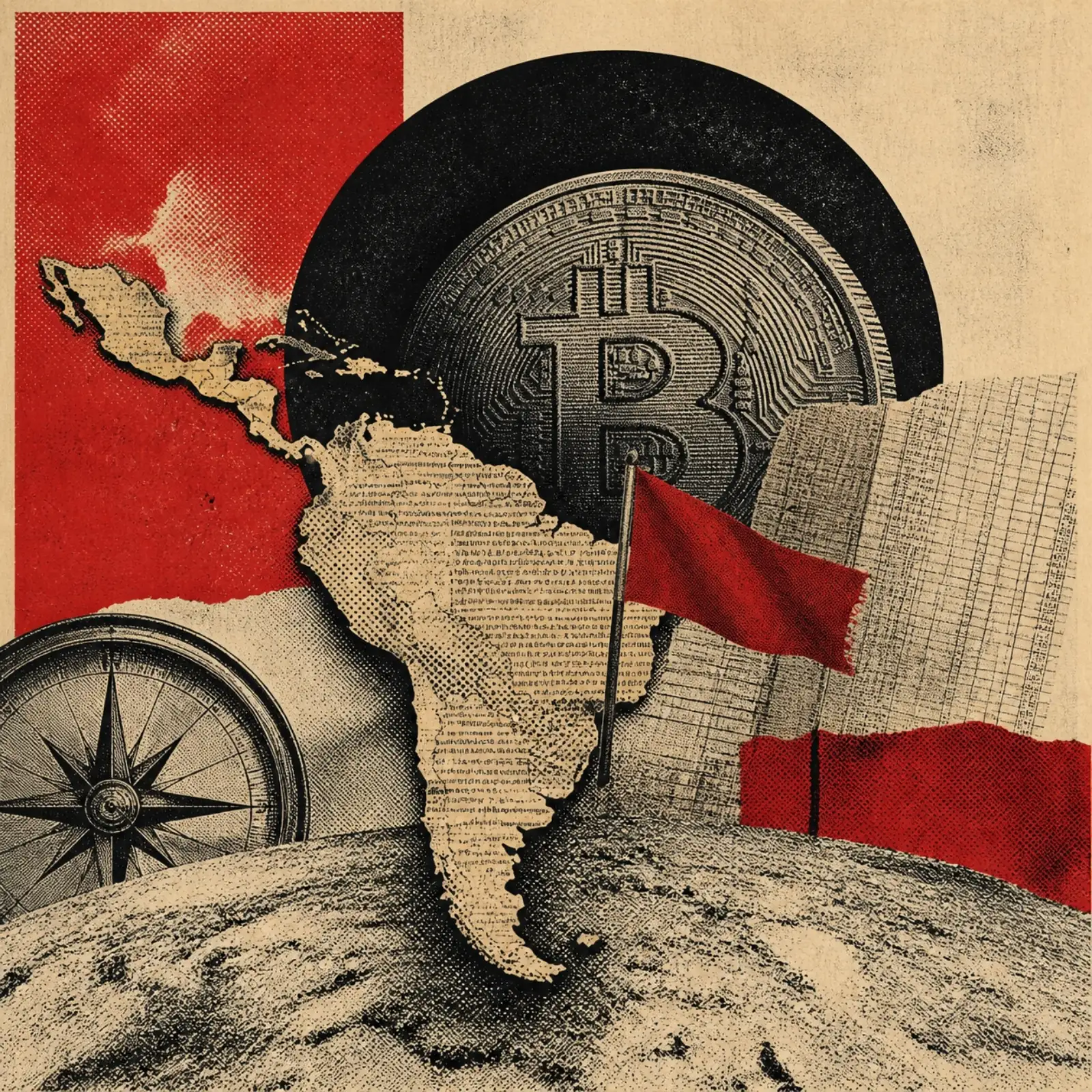
There is a fascinating contradiction in the debate about Bitcoin.
It was conceived as a monetary network that does not depend on central banks. Its issuance is not determined by national governments. Its transactions can cross borders without necessarily using the same chain of intermediaries as the traditional financial system.
For this reason, its supporters often associate Bitcoin with sovereignty.
But whose sovereignty?
The individual's?
The State's?
A community's?
That of countries on the periphery of the international monetary system?
These questions seem similar, but they can produce very different answers.
For a person living under high inflation or capital controls, owning an asset that can be transferred internationally can represent a concrete form of financial autonomy.
For a State, however, adopting a currency it does not issue can mean precisely giving up monetary instruments.
Bitcoin, therefore, introduces a paradox:
what increases the individual's monetary sovereignty may not increase the State's monetary sovereignty.
Understanding this difference is essential to discussing the role of cryptocurrencies in the Global South.
The hierarchy of currencies
The international monetary system is not horizontal.
Some currencies are far better able than others to function internationally as a store of value, unit of account and settlement instrument.
At the center of this architecture remains the US dollar.
Governments, companies and individuals outside the United States hold dollar-denominated assets; international commodities are traded in it; debts are issued in it; central bank reserves remain heavily exposed to the dollar.
This creates an asymmetry that international political economy has known for decades.
The United States issues the system's main currency.
Most countries have to obtain it.
For emerging economies, this difference matters.
Exchange rate shocks, capital flight and debt denominated in foreign currency can significantly limit the autonomy of national economic policy.
It is in this environment that crypto assets begin to enter the discussion on sovereignty.
Does Bitcoin offer a way out?
Bitcoin has a politically unusual feature: no national authority unilaterally decides its issuance.
The protocol sets known supply rules and an international network maintains the system.
For individuals, this can be attractive precisely in countries where trust in monetary institutions is low.
But turning this feature into a complete theory of national sovereignty requires care.
A State that replaces its currency with Bitcoin stops depending on another country's monetary decisions, but it does not come to control Bitcoin either.
It cannot issue BTC in a crisis.
It cannot change its monetary policy.
It cannot act as the network's issuer of last resort.
It does not determine its supply.
In other words, independence from another central bank does not necessarily mean monetary autonomy.
It is a distinction similar to the one found in dollarized economies.
The Salvadoran laboratory
No country has made this debate as concrete as El Salvador.
In 2021, the country made Bitcoin legal tender alongside the dollar.
The experience was presented internationally as a break with the traditional monetary system.
But El Salvador already had a fundamental characteristic before Bitcoin: since 2001, its economy had been officially dollarized.
The country no longer had an independent conventional monetary policy.
For this reason, interpreting the Salvadoran experiment as a simple replacement of a national currency by Bitcoin would be incorrect.
Economists Tobias Boos and Juan Grigera argue that the adoption must be understood in the context of dollarization, international remittances and foreign debt.
In later work, published in 2025, the authors describe the experience as an attempt to gain room for maneuver in an international system dominated by the dollar, an attempt that, according to their analysis, had limited results.
That does not make the case irrelevant.
On the contrary.
It makes El Salvador one of the most interesting laboratories for understanding the difference between monetary innovation and monetary sovereignty.
Remittances matter
There is a concrete reason why this debate is especially important in Latin America and other regions of the Global South: international remittances.
Millions of workers send money to relatives living in other countries.
These transfers can involve intermediaries, fees and currency conversions.
Bitcoin and other open networks present an interesting hypothesis: using global digital infrastructure to transfer value directly.
In certain situations, this can reduce intermediaries.
But once again, the concrete experience is more complicated than the technical architecture.
A family does not pay rent with a monetary thesis.
It needs to convert the asset received into the currency used in daily life.
This means that on-ramp and off-ramp costs, volatility, infrastructure availability, technological knowledge and merchant acceptance matter as much as the protocol.
Efficiency needs to be measured end to end.
Then came stablecoins
Perhaps the most important transformation for the discussion of sovereignty in the Global South is not happening through Bitcoin.
It is happening quietly through stablecoins.
These tokens seek to keep their value tied to traditional currencies, above all the dollar.
The combination is powerful.
On one side, they have the features of crypto infrastructure: digital circulation, round-the-clock availability and integration with blockchains.
On the other, they offer exposure to a currency users already know.
But here an even greater paradox emerges.
Stablecoins can expand individual financial autonomy in countries with fragile currencies and, at the same time, deepen the dollarization of those economies.
In a study published in 2026, researchers at the Bank for International Settlements estimate that roughly 98% of stablecoin value is denominated in dollars.
The political conclusion is relevant.
Decentralized technology does not necessarily weaken the existing monetary hierarchy.
It can also make it more accessible.
The dollar, which previously might have required a specific bank account or access to the international financial system, now circulates through a digital wallet.
For the user, this can mean protection of savings.
For an emerging economy's central bank, it can mean easier substitution of the national currency.
Both things can be true at the same time.
Sovereignty for whom?
This tension reveals a conceptual problem.
We use the word “sovereignty” for different phenomena.
There is individual sovereignty: a person's ability to control their own resources.
There is state monetary sovereignty: a government's ability to manage its currency and monetary policy.
There is economic sovereignty: the room a society has to decide its policies democratically without excessive external constraints.
And there is also technological sovereignty: the ability not to depend entirely on infrastructures controlled by other countries or by a few corporations.
Crypto assets can increase some of these forms and reduce others.
A self-custody wallet can expand individual autonomy.
A dollar stablecoin can protect a family against domestic inflation.
At the same time, mass adoption of that same stablecoin can reduce the effectiveness of national monetary policy.
There is no logical contradiction.
There are different interests operating simultaneously.
A particularly important question for the left
Historically, the Latin American left has paid enormous attention to dependency.
Financial dependency.
Technological dependency.
Commercial dependency.
Monetary dependency.
The expansion of digital financial networks adds a new layer to this debate.
It would be a mistake to dismiss them simply because part of their early political culture was libertarian.
But it would be equally hasty to imagine that technological decentralization automatically produces economic sovereignty.
The question needs to be more demanding.
Who controls the infrastructure?
Who issues the asset?
In what currency is it denominated?
Where are the developers?
Who controls the main on-ramps and off-ramps?
Who has the power to freeze a stablecoin?
Who captures the fees?
Where are the servers and interfaces?
Who sets the rules?
A political analysis of blockchain begins precisely when the word “decentralized” stops closing the discussion.
Bitcoin and the State need not be conceptual enemies
There is also a less spectacular, but perhaps more realistic, hypothesis.
Bitcoin does not need to replace national currencies to be relevant.
It can function as a global asset, an alternative settlement infrastructure or a voluntary reserve for certain participants without becoming an economy's everyday monetary unit.
States, in turn, can continue to operate national currencies, public payment systems and monetary policies.
Coexistence is less revolutionary than the narrative of complete replacement.
But the history of institutions rarely unfolds through instant substitutions.
New layers are added to the old ones.
The Global South is not an empty laboratory
One last caveat is needed.
Developing countries often appear in technology discourse as places where great experiments can finally be carried out.
But these societies are not blank pages.
They have their own institutions, distributive conflicts, communities, territorial rights and economic histories.
Research on El Salvador has drawn attention to exactly this.
Ruchi Patel, studying the rollout of the Bitcoin ecosystem in coastal areas of El Salvador, found territorial and distributive effects that challenge purely technological narratives about development.
This kind of research does not show that Bitcoin is inherently harmful.
It shows something more important:
a technology cannot be judged only by what its protocol promises. We need to look at what happens when it meets a real society.
Sovereignty as the capacity to choose
Perhaps this is the most useful way to reframe the debate.
Sovereignty is not isolation.
Nor is it simply having a currency of one's own.
Sovereignty is having enough political, economic and technological capacity to make choices.
In this sense, open networks can be part of a strategy for autonomy.
But they will hardly be enough on their own.
A country that is technologically dependent, deeply indebted, socially unequal and lacking institutional capacity does not become sovereign just because its citizens can use a blockchain.
Likewise, banning open technologies does not automatically make an economy more independent.
The relevant question lies between these extremes.
Can the Global South use new financial infrastructures without handing its economic policy over to them?
Can it take advantage of open networks without deepening monetary dependencies?
Can it offer citizens financial autonomy while preserving collective public policy instruments?
Can it develop technology instead of merely consuming it?
Bitcoin does not resolve these questions.
But it has forced governments, economists and societies to ask them again.
And perhaps that is one of its most important political contributions.
Because the real debate about sovereignty was never just about who issues money.
It is about who has the capacity to decide their own economic future.
References
- 01ALDASORO, Iñaki; FROST, Jon; ITO, Hiro. The impact of stablecoins on the international monetary and financial system. BIS Papers nº 170. Bank for International Settlements, 2026. In the Library
- 02BOOS, Tobias; GRIGERA, Juan. The political economy of Bitcoin as legal tender in El Salvador: Temporary bandages to permanent wounds? UNU-WIDER Working Paper 136/2023. In the Library
- 03BOOS, Tobias; GRIGERA, Juan. Two legal tenders, no currency: El Salvador’s Bitcoin adoption between world money and international money. Political Economy and Globalization, v. 3, n. 2, 2025.
- 04PATEL, Ruchi. Economic freedom or crypto-colonialism? Materialities of Bitcoin adoption in El Salvador. Geoforum, 2024.
- 05BESPALOVA, Olga et al. Crypto assets and CBDCs in Latin America and the Caribbean: Opportunities and risks. Latin American Journal of Central Banking, v. 6, n. 2, 2025. In the Library
- 06BANK FOR INTERNATIONAL SETTLEMENTS. Dollarisation and monetary control: what lessons for the rise of stablecoins? BIS Working Papers nº 1370, 2026.